
Traditional metals or modern cookware: an honest comparison
Every material in an Indian kitchen does some jobs well and others badly. Here is what the engineering data, regulators and lab studies say about each, and where brass, copper and kansa still earn their place.
Written by Hastimal Valchand LLP from the sources listed below · · 7 min read
In short
- No single material wins: copper and aluminium spread heat best, steel and cast iron are the toughest, and kansa and copper suit the table and drinking water.
- Brass and copper must be tinned (kalai) inside before you cook in them, and none of the three traditional metals works on induction by itself.
- India's 2024 dietary guidelines advise against storing sour food in aluminium, iron or untinned brass and copper, and against overheating non-stick pans.
- Stainless steel is the fair all-rounder, though new pans release small amounts of nickel and chromium into sour sauces simmered for hours.
- Cheap pots and badly fired glazes are the real lead risk; in 2025 the US FDA warned against certain imported aluminium and brass cookware.
From the catalogue
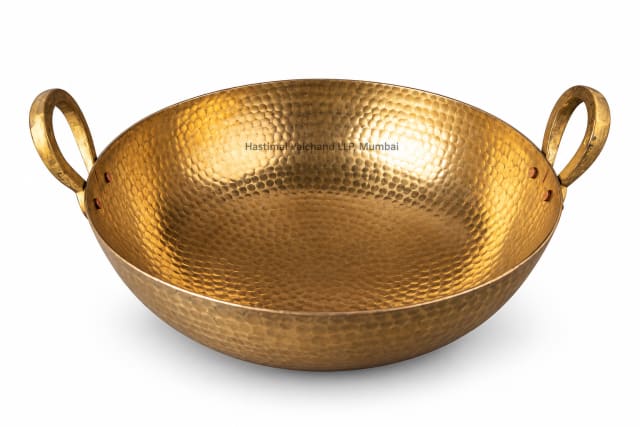
Tasla Kadhai
Sizes: 6-7 · 8-14 · 15-24 · +1
Baby Handi (Hammered)
HV540Brass
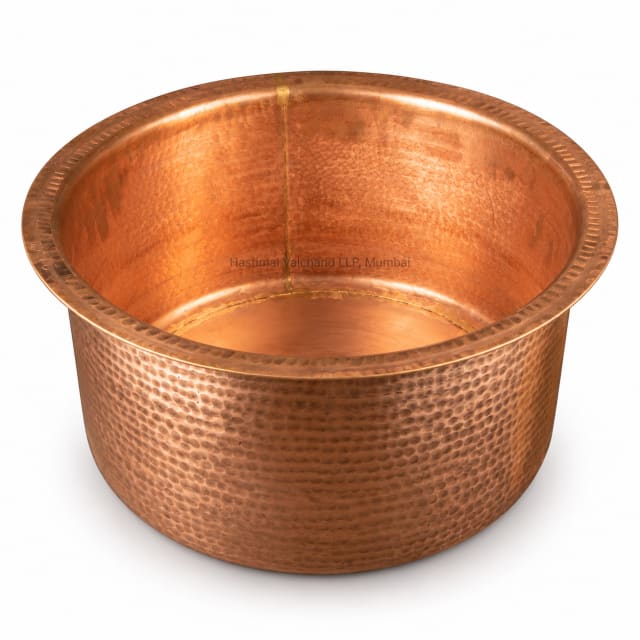
Top (Joint Bottom)
HV261Copper
Mahi Tawa
HV268Copper


01Why the question is back
For much of the last century, Indian kitchens moved away from metal that needed looking after. A Sahapedia study of Old Delhi's tinsmiths records that aluminium, and then stainless steel, replaced copper and brass vessels.
Now buyers ask the opposite question. Is non-stick safe? Is aluminium safe with tamarind and tomato? Were the old metals better? No survey measures how many households have switched back, so we will not guess at a number.
What can be compared is the evidence. That means how each material handles heat, what it gives off into food, and how it fails. Where that evidence favours steel or cast iron, this article says so.
02Side by side
| Material | Heat conduction | Sour food | Induction | Watch for |
|---|---|---|---|---|
| Copper (tamba), tinned inside | Highest, about 390 W/m·K | Only with an intact tin lining | No | Worn lining; never heat empty |
| Brass (pital), tinned inside | Good, about 111 W/m·K | Only with an intact tin lining | No | Worn lining; darkens in air |
| Kansa (bronze) | Low, about 26 W/m·K | Serve it; don't store it | No | Better at the table than on the flame |
| Stainless steel | Poor, about 14 W/m·K; better with a clad base | Yes; long simmering adds some nickel and chromium | Yes, if the base is magnetic | Hot spots in thin, unclad pans |
| Aluminium | High, about 150–236 W/m·K | Don't store it | No | Acid draws aluminium out; scrap-metal pots may carry lead |
| Non-stick (PTFE-coated) | Depends on the pan beneath | Yes, while the coating is whole | Only with a magnetic base | Overheating when empty; scratches; worn coating |
| Cast iron | Moderate, about 52 W/m·K; slow but even | Adds iron; don't store it | Yes | Rust; needs seasoning |
| Glass | For oven and microwave, not the hob | Yes | No | Shatters with sudden temperature change |
| Glazed ceramic | For oven and microwave; most crack on a hob | Yes, if the glaze is sound | No | Lead in badly fired glazes; chips |
03Heat: which materials spread it
Thermal conductivity measures how quickly heat moves through a material. Engineering tables give copper about 390 W/m·K, pure aluminium 236, yellow brass 111, cast iron 52 and type 304 stainless steel about 14.
That is why copper and aluminium pans heat evenly and respond fast when you lower the flame. Stainless steel spreads heat poorly, so better steel pans clad an aluminium or copper core inside the base.
Cast iron is slow to heat, but once hot it heats evenly. Kansa, a high-tin bronze, conducts only about 26 W/m·K, so it suits the table better than the flame.
Induction changes the order. An induction hob heats only ferrous metal, so cast iron and magnetic stainless steel work. Copper, aluminium, brass and kansa need a steel induction disc.
04Non-stick: easy to use, with limits
Most non-stick pans carry a PTFE coating, sold as Teflon. The US FDA Food Code describes it as a stable plastic that food will not stick to and that cleans quickly.
An older worry was PFOA, a persistent chemical found in people's blood. Under a US EPA programme launched in 2006, eight major makers pledged to cut it by 95% by 2010. They were to eliminate it by 2015, and all say they met those goals.
Regulators differ on what risk remains. India's ICMR-NIN guidelines say PTFE pans are a risk above 170 °C, as when an empty pan sits on a burner. Germany's risk agency, BfR, puts the danger point at 360 °C, and the FDA says neither chipped particles nor fumes are a health hazard.
All three agree on the practical rules. Never heat a non-stick pan empty, and use tools that will not scratch it. With water or wet food inside, BfR notes, the pan stays near 100 °C.
The coating sets the pan's life. Once it is worn or damaged, ICMR-NIN advises throwing the pan away.
05Aluminium, sour food and lead
Aluminium is light and spreads heat well. ICMR-NIN says small amounts of metal from cookware need not worry you. It also says sour food such as pickles, chutneys, sambar or khatta dal becomes unsafe when stored in aluminium, iron or untinned brass and copper.
Lab work shows why acid matters. A 2017 German study of aluminium camping dishes found water and oil stayed within the 5 mg/L transfer limit. Water with 0.5% citric acid released 638 mg/L.
Cheap pots add a second risk. A 2017 study tested 42 aluminium pots from ten developing countries. Boiled with dilute acid, 15 released at least 1 microgram of lead per serving. Earlier work by the same team traced such pots to scrap metal.
Lead is not only an aluminium problem. In 2025 the US FDA warned against certain imported aluminium, Hindalium and brass cookware, including unbranded brass topes, that may leach lead. The FDA states there is no known safe level of lead exposure.
The lesson applies to every metal, ours included. Buy from a seller who names the metal and the maker and stands behind its purity, and avoid cookware of unknown origin.
06Steel, cast iron, glass and ceramic: the fair case
Stainless steel earns its place. ICMR-NIN calls it generally safe for cooking, and credits its durability, resistance to corrosion and low reactivity with food. With a magnetic base, it also works on induction.
It is not perfectly inert. A 2013 Oregon State University study simmered tomato sauce in steel for up to 20 hours. After six hours, nickel rose up to 26-fold and chromium up to 7-fold, with new pans releasing the most.
Leaching fell with each use and levelled off after six cooking cycles, though it did not stop. The authors note that oral nickel and chromium can cause skin reactions such as dermatitis.
Cast iron is tough, works on induction and holds even heat. It rusts easily and needs seasoning. In a 1986 study, 90% of 20 foods gained significant iron when cooked in iron, more so when acidic, moist or cooked longer.
Glass and ceramic are the materials ICMR-NIN prefers to plastic in the microwave. Their weakness is breakage. A 2012 paper calculated that soda-lime glass cookware survives only about a 55 °C sudden change, against 183 °C for borosilicate.
Most ceramic pots crack on a hob. Glazes need one more check. The FDA warns that badly fired glazes can leach lead, especially from crude handmade, worn, or bright orange, red or yellow pieces. No amount of washing removes it.
07Where brass, copper and kansa fit
Brass (pital) and copper (tamba) react with sour food. India's food regulator, FSSAI, treats copper or brass containers that are not properly tinned as unfit for food. The US FDA Food Code bars copper and brass from food below pH 6, such as vinegar or fruit juice.
So cook only in vessels lined with kalai, the traditional tin coating wiped on inside. Tin melts at about 232 °C, so never heat a tinned vessel empty, and have it re-tinned when the lining wears.
That lining is also why these vessels last. A worn non-stick pan is thrown away; a worn tinned pot goes back to the tinsmith and returns to the kitchen. Old Delhi's tinners re-tinned household pots every few months.
Their strengths are even heat, serving and water. Tinned copper and brass spread heat well for rice, dal and large batches on gas. Kansa thalis, katoris (watis) and glasses are the traditional metal of the table: serve sour food in them, but do not store it.
For drinking water, copper has some evidence beside the custom. Ayurveda recommends storing water in copper. In a 2012 lab study, contaminated water kept in copper pots for 16 hours showed no recoverable bacteria, with copper at about 177 ppb.
That is one lab study, not proof of a health effect. WHO's drinking-water guideline for copper is 2 mg/L, so use plain water at room temperature, not juice or lemon water.
The drawbacks are real too. None of the three works on induction without a steel disc. Copper and brass darken and need polishing, and tinned vessels need re-tinning from time to time.
08A sensible mix for an Indian kitchen
Hastimal Valchand (HV) makes and supplies brass, copper and kansa vessels for the cooking, serving and water jobs on this list. Ask whether a cooking vessel is tinned inside before you order it.
This article is general information, not medical advice.
- Everyday frying and sautéing: clad stainless steel or cast iron; both work on induction.
- Eggs, dosa and quick sautéing: non-stick, never heated empty, and replaced when the coating wears.
- Rice, dal, milk and large batches on gas: tinned brass or copper topes, handis and degs.
- Serving and dining: kansa thalis and katoris, and brass or copper serveware.
- Drinking water: a copper bottle, jug or lota, filled with plain water at room temperature.
- Pickles, curd and other sour food kept for days: glass, sound glazed ceramic or stainless steel.
Questions people ask
Which utensils are best for cooking and health in India?
No single material is best for every job. ICMR-NIN rates earthen pots safest, calls stainless steel generally safe, and advises against storing sour food in aluminium, iron or untinned brass and copper. Tinned brass and copper suit cooking on gas; kansa and copper suit serving and water.
Is brass better than aluminium for cooking?
For sour dishes, tinned brass is the safer choice: ICMR-NIN advises against storing acidic food in aluminium, and lab tests show acid draws aluminium out quickly. Brass must keep its tin lining to cook safely. Aluminium is lighter and spreads heat faster.
Copper cookware or stainless steel: which is better?
Copper conducts heat about 27 times faster than type 304 stainless steel, so it cooks evenly, but it must be tinned inside and does not work on induction. Steel is tougher, needs no lining and works on induction with a magnetic base. Clad steel pans with a copper or aluminium core combine the two.
Is non-stick cookware safe to use?
Regulators accept PTFE non-stick used as directed. ICMR-NIN warns against heating it above 170 °C, as with an empty pan left on a burner, and advises discarding pans with worn or damaged coatings.
Sources
- ICMR-National Institute of Nutrition (2024), Dietary Guidelines for Indians, Guidelines 12 and 13: safe use of cookware
- Engineering ToolBox, Thermal conductivity of metals, metallic elements and alloys
- Wikipedia, Cookware and bakeware (stainless steel cladding, cast iron, copper linings, glass and ceramic)
- Wikipedia, Induction cooking (which cookware heats)
- US EPA, Fact sheet: 2010/2015 PFOA Stewardship Program
- BfR, German Federal Institute for Risk Assessment (2025), Questions and answers on cookware with a PTFE non-stick coating
- US FDA (2022), Food Code, §4-101.14 Copper, §4-101.18 Nonstick coatings and Annex 3
- Stahl T et al. (2017), Migration of aluminum from food contact materials to food, Part III: camping dishes and utensils, Environmental Sciences Europe 29
- Weidenhamer JD et al. (2017), Metal exposures from aluminum cookware: an unrecognized public health risk in developing countries, Science of the Total Environment 579
- Sultan SAA et al. (2023), Assessing leaching of potentially hazardous elements from cookware during cooking, Toxics 11(7)
- US FDA (2025), FDA warning about imported cookware that may leach lead
- US FDA, Lead in food and foodwares
- US FDA, Questions and answers on lead-glazed traditional pottery
- Kamerud KL, Hobbie KA, Anderson KA (2013), Stainless steel leaches nickel and chromium into foods during cooking, J Agric Food Chem 61(39)
- Brittin HC, Nossaman CE (1986), Iron content of food cooked in iron utensils, J Am Diet Assoc 86(7)
- Bradt RC, Martens RL (2012), Shattering glass cookware, Bulletin of the American Ceramic Society, reported by ScienceDaily
- FSSAI, Food Safety and Standards (Packaging) Regulations, 2018: compendium (2022)
- Wikipedia, Tin (melting point 231.9 °C)
- Sahapedia, Qalai: a waning art (the tinning trade in Old Delhi)
- Sudha VB et al. (2012), Storing drinking-water in copper pots kills contaminating diarrhoeagenic bacteria, J Health Popul Nutr 30(1)
- WHO (2022), Chemical fact sheet: copper, Guidelines for drinking-water quality
Written by HV from the sources above, as general information; not medical, financial or legal advice. For a specific product, send us its code with your question.