
Copper vessels and health: what the research actually says
Water kept overnight in a copper lota is one of India's oldest household habits. Here is what the classical texts, laboratory studies and health agencies each say about it, kept apart.
Written by Hastimal Valchand LLP from the sources listed below · · 6 min read
In short
- In laboratory tests, drinking water stored in a copper pot for 16 hours at room temperature lost all its culturable diarrhoea-causing bacteria.
- We found no study showing that drinking copper-stored water prevents or treats any illness in people.
- Copper is an essential nutrient, but too much upsets the stomach; WHO sets 2 mg per litre as the limit for drinking water.
- Use plain water at room temperature, refill it daily, and keep sour, sweet or hot drinks out of bare copper and brass.
- Brass and kansa are copper alloys and share some of copper's effect on germs, though the evidence for them is thinner.
From the catalogue
Bottle (Yoga)
HV543Copper
Bottle (Prime)
HV538Copper
Bottle (Oreo)
Sizes: Big · Small
Designer Bottle
HV464Copper



01Tamra jal in the tradition
Tamra is the Sanskrit word for copper, and tamra jal is water kept in a copper vessel. The custom is to fill a copper lota or jug at night and drink from it in the morning.
The Sushruta Samhita, a classical Ayurvedic text, describes keeping water in vessels of silver, copper or clay to keep it pure. Researchers who study the practice cite its Sutra Sthana, chapter 45.
Ayurvedic writing goes further and treats copper water as a general tonic. That is a traditional belief. We found no clinical trial that tests it, so this article treats it as tradition, not evidence.
02What the laboratory studies show
The best-known study was published in 2012 by a team from Bengaluru and Kolkata. They added six diarrhoea-causing bacteria, including Vibrio cholerae and Salmonella Typhi, to ordinary drinking water.
The water was kept in 2-litre copper pots at about 26 °C for 16 hours. No bacteria could then be grown from the copper pots, even after an extra enrichment step. In glass bottles, the same bacteria survived or multiplied.
An earlier study from Punjab found a similar pattern in brass. E. coli and coliform bacteria in water kept in a brass mutka could no longer be cultured after 48 hours. This held for water from rural households too.
Conditions matter. Later work showed that temperature and pH change how fast a copper vessel acts on E. coli. Proteins and other organic matter in the water slowed it down sharply, which is one reason to store only plain water.
03Why copper kills germs, and where the evidence stops
On dry copper surfaces, bacteria die quickly. Scientists call this contact killing. A 2011 review by Grass, Rensing and Solioz measured the rate. Bacterial counts fell at least ten-millionfold (7 to 8 logs) per hour.
In February 2008 the US Environmental Protection Agency (EPA) registered copper alloys as antimicrobial touch surfaces. Their labels allow the claim that, cleaned regularly, they kill more than 99.9% of certain bacteria within two hours.
The same labels rule out direct food contact, and say copper supplements standard cleaning rather than replacing it. The registration covers door handles, rails and counters, not utensils or drinking water.
Hospital trials reviewed in 2011 found between 63% and more than 90% fewer bacteria on copper and brass fittings. Fewer germs on a surface is not the same as fewer infections in patients.
The water studies have limits too. They used a handful of bacterial strains, small vessels and controlled water in a laboratory. The 2012 authors could not rule out that some bacteria were alive but unable to grow, and called for tests in real homes.
04Copper as a nutrient
Copper is an essential nutrient. The body uses it in several enzymes, including cytochrome-c oxidase and superoxide dismutase. Clinical copper deficiency is rare.
Most of it comes from food. WHO's background paper on copper puts adult intake from diet at 1 to 3 mg a day. Drinking water usually adds 0.1 to 1 mg.
Water from the copper pots in the 2012 study held 0.177 mg of copper per litre. That is less than a tenth of WHO's limit.
| Measure | Figure | Set by |
|---|---|---|
| Average adult need | About 12.5 micrograms per kg of body weight a day (about 0.75 mg for a 60 kg adult) | WHO (1996), cited by WHO 2004 |
| Recommended intake, adults | 900 micrograms a day | US Institute of Medicine (2001) |
| Tolerable upper intake, adults | 10 mg a day from food and supplements | US Institute of Medicine (2001) |
| Drinking-water guideline | 2 mg per litre | WHO |
| Copper pot water after 16 hours | 0.177 mg per litre | Sudha et al. (2012) |
05When copper becomes too much
WHO's guideline for copper in drinking water is 2 mg per litre. It allows 2 to 3 litres of water a day, plus food and supplements, without upsetting the stomach.
In trials with volunteers, nausea became more common from about 4 mg per litre. Symptoms usually start 15 to 60 minutes after drinking, and nausea and vomiting are more common than diarrhoea. Above about 2.5 mg per litre, water tastes bitter.
Acid draws more copper out of the metal. In the 2012 team's earlier test, slightly acidic distilled water picked up about 420 micrograms of copper per litre. Ordinary tap water picked up 177.
That is why the US FDA Food Code bars copper and brass from contact with food below pH 6. Its examples are vinegar, fruit juice and wine. India's FSSAI treats copper or brass containers that are not properly tinned as unfit for preparing or storing food.
Some people need more care. Wilson disease is an inherited disorder in which copper builds up in the liver, brain and eyes. WHO also notes that some copper outbreaks affected children at lower levels than adults.
06How to use a copper vessel sensibly
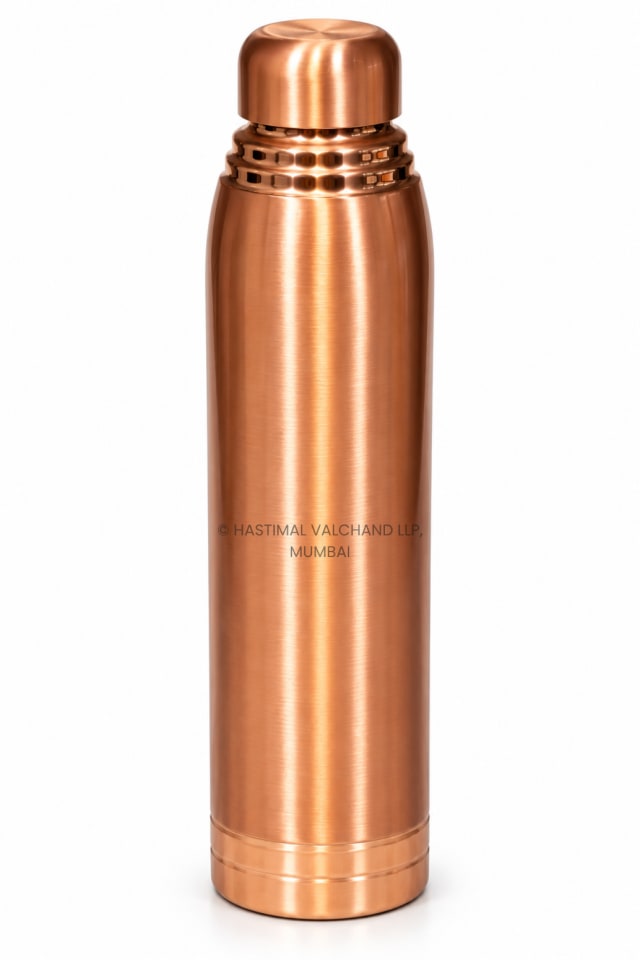
Our copper water bottle guide covers first use, cleaning, and why the inside turns dark. HV makes and supplies copper lotas, jugs, glasses and water bottles, and every piece in the catalogue carries its own code.
- Fill it with plain drinking water at room temperature, the condition the studies tested.
- Drink it within the next day, then empty, rinse and refill. Don't top up yesterday's water.
- Keep lemon water, juice, buttermilk, milk, tea and sweet or fizzy drinks out of bare copper.
- Keep hot drinks out too. The tests were run at room temperature, and the safety figures do not cover hot liquids.
- Cook in tinned (kalai) vessels, not bare copper or brass.
- Treat copper water as part of your daily water, not a dose. For infants, pregnancy, liver disease or Wilson disease, ask your doctor first.
Questions people ask
Is water from copper utensils good for health?
Laboratory studies show copper pots clear common diarrhoea-causing bacteria from stored water within about 16 hours, with copper well under WHO's limit. No study shows that the water prevents or treats illness. Used with plain water at room temperature, it is a sensible way to store drinking water.
Can drinking water from a copper vessel be harmful?
Yes, if the copper level climbs too high. Volunteers reported more nausea from about 4 mg per litre, and WHO sets 2 mg per litre as the limit. Sour, sweet or hot drinks in bare copper raise the level, and people with Wilson disease should ask a doctor.
Do brass and kansa vessels work like copper?
Partly. Both are copper alloys, and a brass vessel cleared E. coli from stored water within 48 hours in one study. We found no study of water stored in kansa, and alloys with less copper act more slowly.
Sources
- Sudha VBP et al. (2012), Storing drinking-water in copper pots kills contaminating diarrhoeagenic bacteria, J Health Popul Nutr 30(1):17–21
- Pruthi Z et al. (2022), Effect of Ayurveda water purification method on total dissolved solutes in water, Ayu
- Mudiar R, Kelkar-Mane V (2020), Targeting fungal menace through copper nanoparticles and Tamrajal, J Ayurveda Integr Med
- Math MV et al. (2019), Role of hand washing and water storage in copper tank on incidence of diarrhea (letter), Indian J Community Med 44(1):71
- Tandon P, Chhibber S, Reed RH (2005), Inactivation of Escherichia coli and coliform bacteria in traditional brass and earthernware water storage vessels, Antonie van Leeuwenhoek 88:35–48
- Sharan R et al. (2010), Inactivation and injury of Escherichia coli in a copper water storage vessel: effects of temperature and pH, Antonie van Leeuwenhoek 97:91–97
- Sharan R et al. (2010), Inactivation and sub-lethal injury of Escherichia coli in a copper water storage vessel: effect of inorganic and organic constituents, Antonie van Leeuwenhoek 98:103–115
- Grass G, Rensing C, Solioz M (2011), Metallic copper as an antimicrobial surface, Appl Environ Microbiol 77(5):1541–1547
- US EPA (29 February 2008), Notice of pesticide registration 82012-1, Antimicrobial Copper Alloys Group I, with label
- US EPA (29 February 2008), Notice of pesticide registration 82012-5, Antimicrobial Copper Alloys Group V, with label
- WHO (2004), Copper in drinking-water: background document for the Guidelines for Drinking-water Quality (WHO/SDE/WSH/03.04/88)
- ATSDR, US CDC, ToxFAQs: Copper
- US FDA Food Code §4-101.14 (copper use limitation), as adopted in Minnesota Rules 4626.0465
- FSSAI, Food Safety and Standards (Packaging) Regulations, 2018: compendium, version III (2022)
- Vocabulary.com, “bell metal”
Written by HV from the sources above, as general information; not medical, financial or legal advice. For a specific product, send us its code with your question.