
A short history of metal utensils in India, from Harappa to the bazaar
Indians have cooked, served and worshipped with copper and its alloys for more than four thousand years. Here is that story, told from excavation reports, Mughal records and craft registers.
Written by Hastimal Valchand LLP from the sources listed below · · 6 min read
In short
- Copper and bronze vessels were dug up at Mohenjo-daro in the 1920s, and the Harappan civilisation is classed as a Bronze Age culture.
- Around 1590 the Ain-i-Akbari recorded recipes for brass (pital) and for a four-to-one copper-tin bell metal, and noted that the imperial kitchen's copper was tinned twice a month.
- Kalai, the tin lining inside copper and brass cookware, is dated by historians to about 1300 CE.
- Two living centres are formally recognised: the Thathera craft of Jandiala Guru (UNESCO, 2014) and Moradabad Metal Craft (Geographical Indication, 2014).
- Aluminium and stainless steel displaced brass and copper from most kitchens after the 1950s; reports since describe a partial return, though no national sales data yet shows its size.
From the catalogue
Lota with Lid (Sheet) Round
HV517Brass
Urli Standard
HV482Copper
Flora Thali
HV501Brass
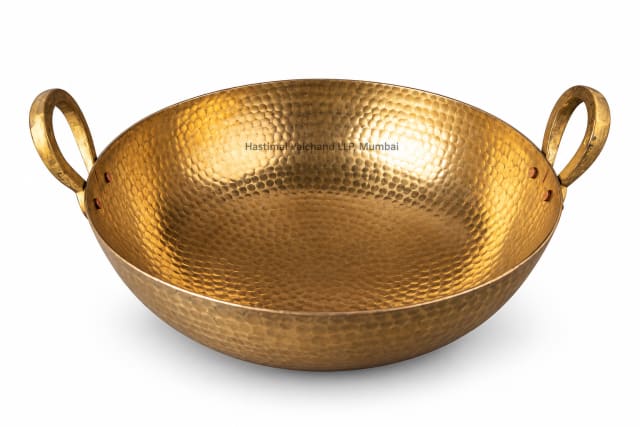
Tasla Kadhai
Sizes: 6-7 · 8-14 · 15-24 · +1


01The timeline at a glance
The story runs from Bronze Age cities to today's wholesale lanes. Each row below comes from an excavation report, a Mughal record, a register or a named writer, all listed at the end.
| Period | What the record shows |
|---|---|
| Third millennium BCE | Harappan cities use copper and copper-based alloys; copper and bronze vessels are later found at Mohenjo-daro. |
| About 1300 CE | The earliest date historians give for kalai, the tin lining of copper and brass vessels. |
| About 1590 | The Ain-i-Akbari records recipes for brass and bell metal, and the tinning of the imperial kitchen's copper. |
| 1699 | The Sanskrit Sivatattva Ratnakara mentions kalaya-lepa, tin coating. |
| 1950s onwards | Aluminium, then stainless steel, replace tinned brass and copper in most kitchens. |
| 2014 | UNESCO inscribes the Thathera craft of Jandiala Guru; Moradabad Metal Craft receives its GI certificate. |
| 2020s | Writers and kalaiwalas report a partial return to copper and brass cookware. |
02Copper and bronze in the Indus cities
The National Museum in New Delhi describes the Harappan civilisation as a Bronze Age culture. It says so because so many of its objects are made of copper-based alloys. Its best-known bronze, the small 'dancing girl' figurine, shows how far Harappan metalworking had advanced in the third millennium BCE.
Vessels survive too. The official account of the Mohenjo-daro excavations of 1922 to 1927, published in 1931, describes copper and bronze jars, dishes and covered bowls. Ernest Mackay, who wrote that chapter, thought the copper pieces were raised from sheet metal. Some bronze dishes, he argued, were cast, and cleanly enough to have been trued and polished.
Mackay saw bronze as the bigger step. Copper is easy to shape, he noted, but a thin copper pot bends and dents. Bronze is harder to work, yet the finished vessel is stronger. Many metal pieces copied the shapes of the city's clay pots, and copper and bronze vessels were found lying together. Most had flat bases for brick and mud floors; round-bottomed ones probably sat on pottery rings.
He also found metal vessels rare, and guessed that residents took their most valued things when they left. Even in 1931, he added, copper vessels were bought by weight rather than by size. A dented one went to the coppersmith, and an old one was credited against a new one. Weight-based pricing still works this way, as our guide to how utensils are priced explains.
03Brass and kansa in Akbar's records
The Ain-i-Akbari, Abul Fazl's record of Akbar's empire, was compiled around 1590. In H. Blochmann's 1873 translation, one chapter lists alloys made 'for ornaments, vessels, etc.' The first is four parts copper to one part tin: the bell-metal bronze India knows as kansa.
Brass follows, 'which the Hindus call pital'. The text gives three recipes. Two give a brass that can be hammered, one cold and one hot. The third is not worked with the hammer but cast. Our own catalogue still marks some brass pieces as sheet and others as casting.
The same book describes the imperial kitchen. Food went to the table in gold, silver, stone and earthenware dishes, and copper dishes were wrapped in white cloth. Copper utensils were tinned twice a month, and broken ones went to the braziers to be made into new ones.
04Kalai: the tin lining that made copper cookware usable
Kalai (also qalai) is a thin coat of tin wiped over the inside of a copper or brass vessel. It keeps acidic food from reacting with the bare metal. Historians, following P.K. Gode, date the practice in India to about 1300 CE. Kalai-lined vessels have been excavated at Brahmapuri near Kolhapur.
Sahapedia records the method. The kalaiwala heats the vessel over a coal fire and drops a small piece of tin onto the hot surface. He spreads it until an even lining forms. The Ain-i-Akbari's 'twice a month' shows how often a busy kitchen needed it redone.
The trade shrank as households gave up copper and brass. Hyderabad's kalaiwalas told Telangana Today in 2026 that their numbers fell sharply once stainless steel and aluminium arrived. For the process today and when to re-tin, see our kalai guide.
05The Thatheras of Jandiala Guru
In 2014 UNESCO inscribed the brass and copper utensil craft of the Thatheras of Jandiala Guru, Punjab. It sits on the Representative List of the Intangible Cultural Heritage of Humanity. Platts' 1884 dictionary defines a thathera as a maker of metal pots and pans, a brazier.
UNESCO's description follows the work step by step. Cooled cakes of metal are flattened into thin plates, then hammered into curves over small wood-fired stoves set into the ground. Bowls, rimmed plates, water and milk pots and large cooking vessels are finished with sand and tamarind juice. Rows of tiny hammered dents make the pattern, and the skill passes orally from father to son.
06Moradabad, the brass city
Moradabad in Uttar Pradesh is called Peetal Nagri, 'brass city', in the local language. The district administration says the name comes from its large export of brass handicrafts to North America and Europe.
Moradabad Metal Craft is a registered Geographical Indication. The Moradabad Handicrafts Exporters Association filed the application on 9 February 2009, and the certificate is dated 31 March 2014. Uttar Pradesh also names metal craft as Moradabad's product under its One District One Product scheme.
07Brass and copper at weddings and pooja
Metal vessels have never been only for cooking. UNESCO notes that Thathera utensils are made for ritual as well as everyday use, including for weddings and temples. The kalash, a pot with a wide base and small mouth, is made in brass, copper, silver or gold. It is worshipped at Hindu marriage and childbirth ceremonies and at griha pravesh, the house-warming.
When steel took over the kitchen, brass and copper stayed in the trousseau. Writing on Old Delhi for Sahapedia, Yusra Hasan records that they remained an important part of wedding trousseaus. They came out on special occasions, especially in Muslim households. For which metal suits which pooja or table piece, see brass, copper or kansa.
08From steel back to brass and copper
In South Indian kitchens, writes Prema Srinivasan, tinned brass vessels were the order of the day until the 1940s and 1950s. During the 1950s they slowly fell out of use because they were hard to maintain. Lighter, low-maintenance stainless steel replaced them, and large aluminium vessels took over cooking at scale. Hasan describes the same order in Old Delhi: first aluminium, then stainless steel.
The return is real but small, and hard to measure. Hasan reports 'some amount of revival' in copper and brass in recent years, with a 'relative resurgence' of kalai work. In Hyderabad, kalaiwalas say many restaurants now cook haleem and biryani in copper, and more people are coming back to traditional cookware. We found no national sales figures that put a size on this.
The old trade never left some streets. In south Mumbai, Kalbadevi, beside Bhuleshwar, still counts utensil sellers among its traders. Hastimal Valchand & Co. opened in Mumbai in 1963, and we trade today from Jawahar Mansion on Thakurdwar Road. Our brass, copper and kansa pages show what that trade looks like now.
Questions people ask
How old are metal utensils in India?
Copper and bronze vessels were found at Mohenjo-daro, a Harappan city of the third millennium BCE. The 1931 excavation report describes copper and bronze jars, dishes and covered bowls found together.
When did Indians start using brass utensils?
Brass was in established use by Mughal times. The Ain-i-Akbari of about 1590 gives three recipes for brass, 'which the Hindus call pital', two for hammering and one for casting.
Why did Indian kitchens switch from brass to stainless steel?
Tinned brass and copper needed regular polishing and re-tinning. From the 1950s, lighter, low-maintenance stainless steel, and aluminium for large-scale cooking, replaced them in most homes.
Why is Moradabad called Peetal Nagri?
Peetal Nagri means 'brass city'. The district administration links the name to Moradabad's large export of brass handicrafts, and Moradabad Metal Craft has been a registered Geographical Indication since 2014.
Sources
- National Museum, New Delhi, Harappan Civilization gallery
- Mackay, E. (1931), 'Copper and bronze utensils and other objects', in J. Marshall (ed.), Mohenjo-daro and the Indus Civilization, vol. II, Arthur Probsthain, London (Internet Archive)
- Abul Fazl (c. 1590), Ain-i-Akbari, vol. I, trans. H. Blochmann (1873), Ain 13 and Ain 23 (Internet Archive)
- Kalai (process), Wikipedia, citing INTACH, 'History of tin-coating of metallic utensils in India'
- Hasan, Y., 'Qalai: a waning art', Sahapedia
- Khan, A.Y. (2026), 'Hyderabad's last kalaiwalas keep centuries-old copper tinning tradition alive', Telangana Today
- UNESCO (2014), Traditional brass and copper craft of utensil making among the Thatheras of Jandiala Guru, Punjab, India
- Intellectual Property India, GI Registry, application 161, Moradabad Metal Craft
- District Moradabad, Government of Uttar Pradesh, History
- One District One Product, Uttar Pradesh, Moradabad
- Kalasha, Wikipedia
- Srinivasan, P. (2024), 'All about utensils from the Peninsula', excerpt from Pure Vegetarian, Down To Earth
- Kalbadevi, Wikipedia
- Bhuleshwar, Wikipedia
- Platts, J.T. (1884), A Dictionary of Urdu, Classical Hindi and English, 'thathera' (Digital South Asia Library)
Written by HV from the sources above, as general information; not medical, financial or legal advice. For a specific product, send us its code with your question.