
A Mumbai metal house since 1963
Hastimal Valchand & Co. opened in Mumbai in 1963, trading in brass, copper and kansa utensils. The same family runs it today as Hastimal Valchand LLP, from Jawahar Mansion on Thakurdwar Road.
We make and supply the vessels India cooks, serves and prays with. Topes and degs for commercial kitchens. Thalis, bowls and glasses for the table. Lotas, urlis and kalash for pooja. Copper bottles and jugs for everyday water.
They go to wholesalers, retailers, hotels, restaurants, caterers and institutions, and to families buying for their own kitchen.
- States served
- 20+
- Cities
- 300+
- Wholesalers, distributors and retailers
- 600+
- Customers reached by our products
- 10,00,000+
§ 01Our story
What we make
The range runs from the commercial kitchen to the pooja room. Kitchen vessels in brass and copper: the tope and deg (deep cooking pots), handi, kadhai, the langdi and lagan (wide, low cooking pots) and the parat (a dish for kneading dough). Tableware in kansa and brass: thalis, bowls, glasses, spoons. Drinkware, serveware, storage, gift and pooja pieces.
Every product has a code, and every size has its own code. Quote HV239 and a size, and there is no doubt which parat you mean.
The whole range is on one page, with every code and size, for anyone who would rather read a list than browse.
Across brass, copper and kansa
The whole catalogueRing Deg
HV529Brass
Ghee Pot (Patili)
HV481Brass
Deg (Degchi)
HV82Copper
Bottle (Yoga)
HV543Copper
Apple Set
HV516Kansa
Serving Bowl (Donga)
Sizes: 500ml · 700ml · 1200ML


§ 02Our story
Brass, copper and kansa
We work in three metals, and each does a different job. Brass, copper with zinc, is the metal of the Indian kitchen and the temple. Copper conducts heat best and is the traditional metal for drinking water. Kansa, copper with tin, is the metal for eating and serving.
Every product is listed under its metal, so you always know what you are buying. Brass and copper that will touch cooking food should be lined with tin, called kalai. India's food regulations treat unlined vessels as unfit for food.
§ 03Our story
Hand work
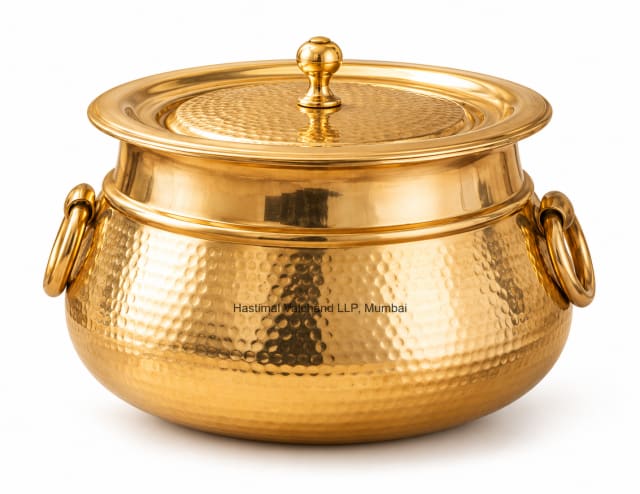
Some of our pieces are still shaped, hammered and finished by hand. The facets on a hammered handi and the soft shine on a hand-finished kansa thali come from that work.
We commission the artisans who make them again and again, and we encourage them to bring their own designs. Steady orders are what keep a craft like this practised, and passed on.
§ 04Our story
Working with the trade
Most of what we sell goes to businesses that sell it on or use it every day. So the catalogue is built for ordering.
Plain vessels are usually priced by weight and finished pieces by the piece, on the day's metal rate.
§ 05Our story
Newer designs
The traditional vessels change little. Around them, the range keeps growing: copper bottles in several designs, hammered and etched serveware, coffee filter sets, coloured masala boxes.
New pieces appear first under new arrivals, each with its code and sizes.